The Transmission at Low Tide
Darwin in the build-up is a city of suspension. The air sits heavy, expectant, and the sea flattens into a sheet of hammered pewter. For a tidal energy analyst, the rhythms of the coast are not poetry; they are spreadsheets, tide tables, and the quiet hum of a computer modelling the flow of water through the Clarence Strait. For Lucas, they had also become a kind of internal clock. A countdown.
He had lived with the tides of this frontier city for twelve years, a relationship that began when he was a postgrad at Charles Darwin University and had hardened into something routine. For ten of those years, he had been with Eleanor, and for the last six, they had been the parents of a daughter, Elsie. Their life was a careful, well-respected structure: the house in Nightcliff with the jackfruit tree in the backyard, the Friday night fish and chips at the Rapid Creek markets, the school runs that mapped neatly onto the grid of Darwin’s suburbs. He was a man of graphs and predictable data. Until he wasn’t.
The Transmission
It began as a small, static hum in the system. A message sent at a time he would never have previously considered, late afternoon, when the light turns gold and punishing. He’d come home from a site assessment at East Arm, his shirt damp with salt and sweat, and he’d looked at his phone not as a tool, but as a portal. The transmission was clean, technical, the kind of language he used for work. But it was loaded. He didn’t justify it. He didn’t apologise to himself. He simply chose to write back.
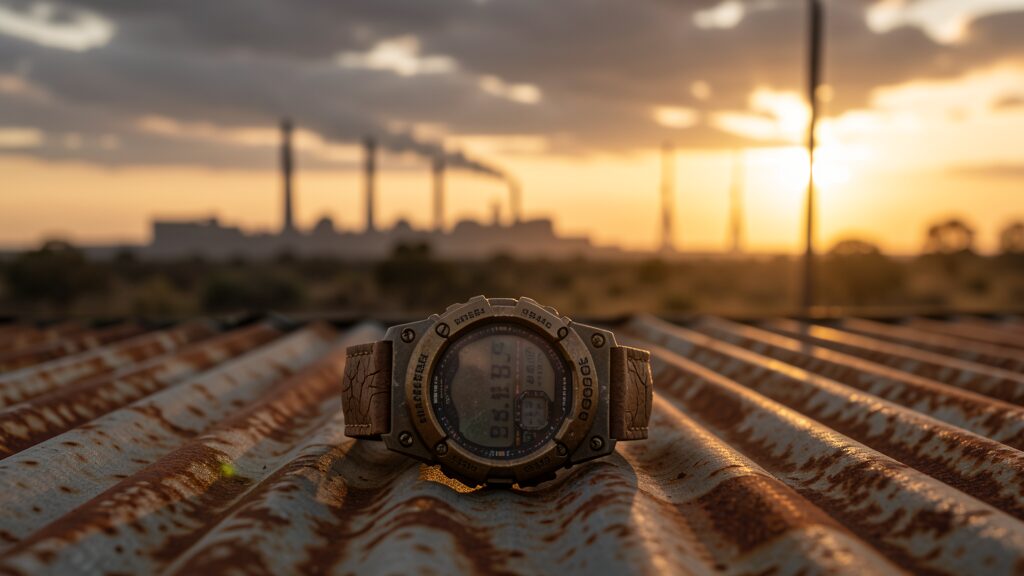
This was not a descent. It was an ascent. A recalibration of the self that had been flattened into the role of father, partner, provider. He had become a function, like the turbines he monitored. Someone who was needed, but no longer seen. The shift was visible in the smallest things. For years, he had worn a particular watch, a gift from Eleanor for their fifth anniversary, a rugged G-Shock that could handle the field work. He had never taken it off, not even to shower. Now, in the quiet minutes before he walked through his own front door, he found himself looking at the face of the watch, and seeing only the time. He no longer saw the gesture. He saw the obligation.
The Tide
The Northern Territory News had recently run a piece about the ‘small but mighty’ festival that defines Darwin’s winter, the Darwin Festival. It was a story about resilience, about a frontier capital finding its voice through art. Lucas read it one Sunday morning, sitting on the cracked concrete of his veranda while Elsie played with a garden hose in the yard. The article, as reported by the ABC, spoke about the festival’s origins as a celebration of survival after Cyclone Tracy, a defiant act of creation. It struck him. There was a version of himself, the 24-year-old who had moved north with a rucksack and a vague idea of adventure, who had understood that. That version of Lucas had not needed permission to feel alive.
Now, the anticipation of the next message was his own small, private festival. He did not think of the woman at the other end as a person to be explored, but as a horizon. He knew her voice only from a single phone call, low, with a laugh that was hesitant, like static clearing. He knew the shape of her work, a marine geologist specialising in benthic habitats, but not the shape of her day. That was the point. The not-knowing was the engine. He would sit in his car on the way to the oil and gas terminal at Wickham Point, and he would smell the salt and the hot plastic of the dashboard, and he would wait for the vibration in his pocket. The vibration was a sound, a tactile promise. Everything before that vibration was a grey, flat line on a graph. Everything after was a spike.
The Wait
The days between their planned meetings were a different kind of tide. A low tide, where the mudflats of his domestic life were exposed for everyone to see. He felt a strange, possessive urge to hold onto the feeling of anticipation. It was a luxury he had not known he was allowed. He remembered his colleague, Raj, who collected vintage slide rules and could spend an hour talking about the logarithmic scales on a 1958 Pickett N-16. Raj was a man of deep, quiet obsessions. Lucas had never understood him. Now, he did. The obsession was not the object; it was the focus. The way a single, specific interest could hold a man above the daily current.
He found himself buying a new notebook. Not for work. For the feelings. He had no intention of writing in it, but the feel of the thick, cream paper was a sensory promise. He would run his thumb over the spine in the middle of a team meeting, and the texture would transport him. He was not a liar. He was a man claiming a territory of self that had been ceded to the routine. He looked at Eleanor across the dinner table, her face tired from a shift at the hospital, and he felt no guilt. He felt a strange, crisp distance. She was talking about the school’s upcoming fete. He was listening to the sound of the air conditioner cycling on and off, a rhythmic pulse that matched the one in his throat.

The Recalibration
A recent cultural reference had lodged itself in his mind. He’d watched a documentary series on the 1974 cyclone, the one that flattened the city. It wasn’t the destruction that stayed with him, but the footage of the clean-up. The way people moved with a single, clear purpose. No ambiguity. For the first time in a decade, Lucas understood that clarity. The affair was not a lie; it was a lens. It made his life in focus. The hours with Elsie at the beach at Casuarina, building sandcastles that the rising tide would inevitably destroy, were more vivid. The colours were sharper. The feeling of the fine, quartz sand between his fingers was no longer just child’s play; it was a tactile truth.
He did not let himself feel sorrow. He would watch the evening news, which occasionally ran stories about the darker side of Darwin, the ‘three alleged escapes from custody in one month’ that was labelled a major concern, a reminder that the frontier was still raw. But Lucas’s frontier was internal. His escape was from a prison of implied permanence. The 34-year-old unfaithful husband in Darwin was not a statistic; he was a man who had decided that his own breathing was worth the risk. The waiting was its own form of breathing. The hours before he would see her again, a Tuesday afternoon, a place near the Waterfront Precinct, neutral and public, were a held breath.
The Bearing
He had chosen. There was no ‘should’ or ‘should not’ in the calculus. There was only the vector of his own desire. He thought of the navigational buoys he studied, their simple, stubborn light in the dark of the Beagle Gulf. They were not asking for permission. They were just signalling a way through.
The article about the Darwin Festival, that small, mighty act of defiance, stayed with him. It was about a city refusing to be defined by its isolation or its history. Lucas understood. He was refusing to be defined by his history, by the 10-year relationship, by the 6-year-old daughter. He was not abandoning them. He was redrawing the map, and in that redrawing, he was including a new, secret coastline. A place where the watcher was also the watched, the one who waited was also the one who was sought.
He stood in front of his own bathroom mirror one morning, before the house was awake. He did not look for wrinkles or grey hairs. He looked for the person who had made the choice. He saw a man with a quiet smile, a man who knew the precise weight of a secret, and found it light. The G-Shock was back on his wrist for the day’s work, but its weight was different. It was a souvenir of an old life. The real time was kept in the silence of his own chest, counting down until the next transmission. He picked up his keys. The day ahead was a flat line. But the afternoon held a spike.
Meet discreet married men in Darwin
Join a discreet and welcoming community.