The Geography of Want: A Married Lesbian in Leeds
The Yorkshire Evening Post ran a story the other day about Karl Darlow leaving Leeds United. I read it on my phone while waiting for the kettle to boil, a domestic pause so ordinary it felt almost violent. The goalkeeper’s departure was a small tremor in the city’s footballing weather, nothing to do with me. But it marked a date. That was the morning after the last time I saw her. I don’t follow football, but I now associate Karl Darlow with the precise moment I started counting hours until the next encounter. That is the kind of associative nonsense my brain does now. I am a married lesbian in Leeds, thirty-three years old, an urban ecologist by trade, and I am having an affair.
Let me be clear: this is not a confession. I feel no guilt, only a kind of electric gratitude. I have been married for seven years to a woman I still love, she is a good person, a brilliant mother to our three-year-old daughter, and I do not intend to leave her. The affair is not a threat; it is a supplement, a secret garden I tend with quiet precision. I own my choices. I do not apologise for them. The trick is to hold two truths at once: I am a devoted wife and mother, and I am also a woman who, on Tuesday afternoons, slips out of her own life and into another’s.
The Hyde Park Book Club
The first time we met outside of work, she suggested the Hyde Park Book Club. It is a café and event space tucked into the student-heavy streets of Headingley, a place where the coffee is good and the walls hold art prints you might actually want to buy. I arrived early, ordered a flat white, and watched the door. I had just finished reading Detransition, Baby by Torrey Peters, a novel that, among other things, examines the messy geometry of queer desire and motherhood. I had underlined a sentence: “You can love someone and still need something they cannot give you.” That sentence followed me into the café, settled on my tongue like the bitterness of the coffee.
She arrived ten minutes late, apologising, her hair still damp from a shower. I noticed the small things: the way she unzipped her jacket as if she were undressing for the first time, the slight turn of her wrist as she set her bag on the chair beside her. We talked about the book. She hadn’t read it, but she listened as if the words mattered. That was when I understood that being seen is not the same as being known. My wife knows my habits, my allergies, my sleep cycle. But this woman saw me the way a stranger sees a landscape, with fresh, unburdened eyes.
That first meeting ended with a handshake that lasted a second too long. The Hyde Park Book Club became our neutral ground. I still go there alone sometimes, to read or to pretend, and the smell of roasted beans and wooden floorboards hauls me back to that afternoon. I do not regret a single minute of the wait.
The Towpath by Granary Wharf
Leeds has a canal system that runs like a dark vein through the city. The towpath near Granary Wharf is where I go when I need to think. It is a thin strip of gravel and cobble between the water and the backs of converted warehouses, and it smells of damp stone and algae. I walked there last Thursday, after dropping my daughter at nursery, and the silence of the water made me think of her voice. She has a low, unemphatic voice that does not demand attention, which is precisely why I strain to hear it.
Before the affair, I walked this towpath as a routine chore, legs moving, earbuds in, listening to a podcast about urban rewilding. Now I walk it without earbuds. I listen for the sound of a bicycle bell, because she cycles through Leeds and sometimes I imagine her coming around the bend. I never see her there; the towpath is our before and after place, never our during. But the anticipation is a form of possession. I hear the splash of a moorhen, the rumble of a train on the viaduct above, and I think: she is not here, but I am waiting, and waiting is its own kind of desire.
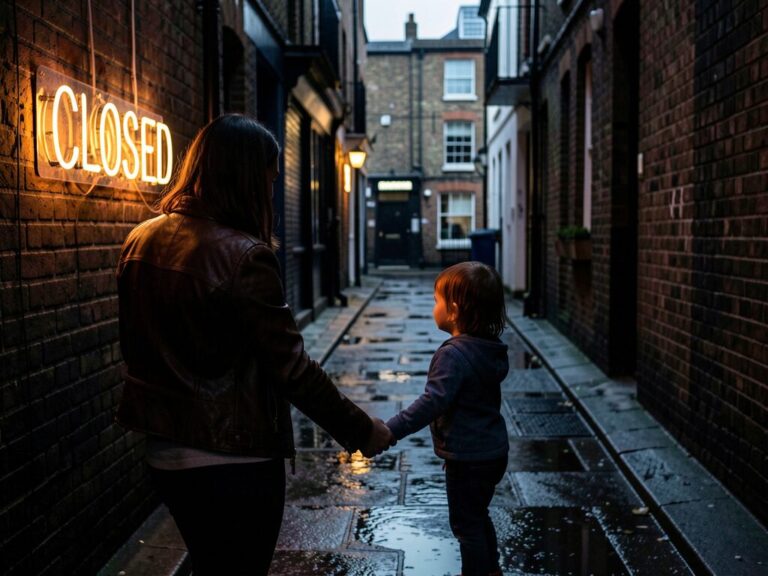
A memory surfaces from a decade ago: I was a cycle courier in Manchester for three summers. I knew every rat-run, every back alley, every shortcut through the Northern Quarter. The job taught me that cities have secret codes, a certain graffiti tag that means a one-way street is porous, a particular cobblestone that will swallow your wheel. That skill, that attention to hidden routes, now applies to my life. I know the gaps in my schedule, the minutes no one will notice, the turnings off the main road. The towpath is one such gap.
The Tetley
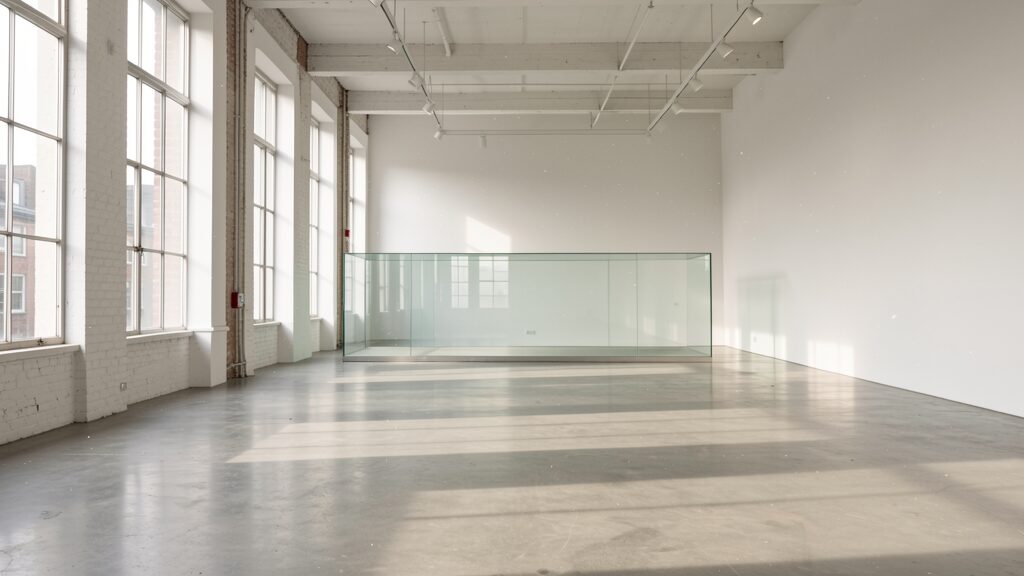
The Tetley is an art gallery and bar housed in the former brewery headquarters on Hunslet Road. It is airy and industrial, with high ceilings and a concrete floor that amplifies footsteps. I meet her there sometimes, in the middle of the afternoon, when the gallery is quiet. We do not touch. We stand in front of installations and talk about the work, but the real conversation happens in the spaces between words. I watch her reflection in the glass of a display case; she watches me in the corner of her eye.
Before this, I was invisible. Not in a tragic sense, I had colleagues, friends, a wife who loves me. But I was a role. Wife. Mother. Urban ecologist. A set of functions performed reliably. In the moments before an encounter, I catch my own reflection in the polished metal of a gallery bench and I see someone else. A woman who is about to be chosen. Not chosen for something, picking up the toddler, signing the permission slip, approving the grant application, but chosen as something. Desired.
The Tetley smells of cold air, dust, and the faint trace of old hops. That smell now reminds me of the sharp inhale she takes just before she speaks. I do not need to describe what happens after we leave the gallery. The anticipation is richer than the act. The two hours between seeing her reflection and walking out the door are more vivid than the entire week that follows.
Kirkgate Market
Kirkgate Market is a Victorian cathedral of commerce, and on Saturday mornings it is a chaos of fruit vendors, cheese stalls, and the smell of fresh dough from the bakery. I go with my wife and daughter to buy organic carrots and artisanal sourdough. We move through the crowd like a unit, our daughter perched on my wife’s shoulders, tiny hands gripping her hair. I am present. I kiss my wife’s cheek. I laugh when my daughter tries to grab a raw sausage. I am a good mother.
But I also scan the crowd. Not obsessively, I am not looking for her. I am looking for the possibility of her. The back of a dark coat, the flash of a messenger bag. I do not find her, and I do not want to. Kirkgate Market is my time, not ours. Yet the scanning is a reflex now, a muscle trained by desire. It does not diminish the joy of my family; it adds a secret layer, like a watermark on a banknote. Only I can see it.
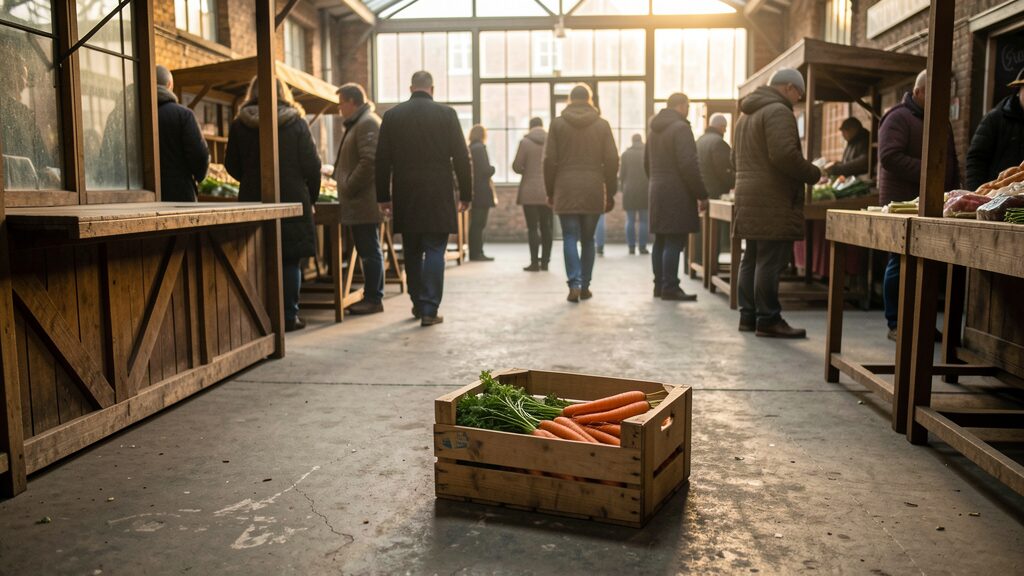
The bag of organic carrots feels heavier than it should. That is the weight of duplicity, but it is not a burden. It is a privilege. Every married lesbian in Leeds who has ever wanted something more without wanting less of what she has will understand this. The market is full of people performing contentment. Some of them are faking it. I am not, I am genuinely content. But I also have a second life, and that life makes the first one more precious. Like a truffle oil drizzled over a plain dish.
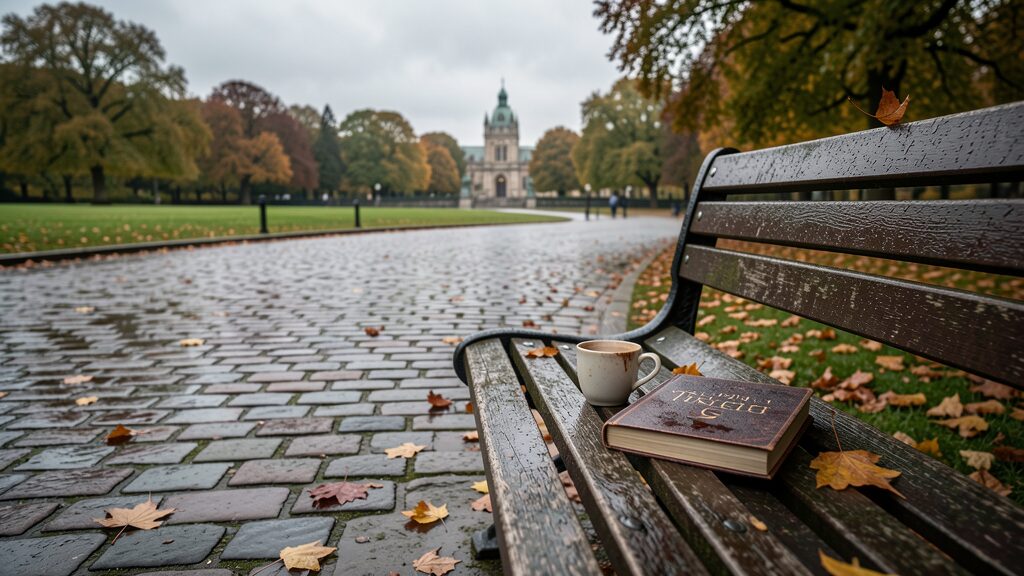
A Bench at Roundhay Park
Roundhay Park is a sprawling green space on the northern edge of Leeds, with lakes, woodlands, and a Victorian mansion that serves as a café. The bench I am thinking of is halfway along the path that skirts Waterloo Lake. It is weathered, slightly warped, and faces the water. I sat there alone one early morning last autumn, before the clocks changed. The mist was still rising off the lake, and the air smelled of wet leaves and cold stone. I had not seen her in three weeks. The silence between meetings is a kind of fasting.
I used to think that silence was the opposite of desire. Now I know it is the vessel. Those three weeks were filled with the ordinary music of my life: the morning argument over whose turn it is to change the nappy, the hum of the washing machine, my daughter’s repeated demand for a specific blue bowl. But beneath that noise, a different sound: the memory of her voice saying my name, the imagined texture of her ribbed jumper under my fingertips. I sat on that bench and let the mist soak into my coat, and I did not check my phone. I wanted to postpone the moment of connection, to stretch the wanting like warm taffy.
That bench is not a place we have ever been together. It belongs to me alone. But it is the place where I feel most acutely the transformation I have undergone. Before the affair, I would have sat there and felt the weight of responsibility, the report due Friday, the nursery fees, the maternal worry about speech development. Now I sit there and feel my own weight. The density of a woman who is chosen, who chooses, who dares to hold two lives in one body. The lake is grey and indifferent. The city hums beyond the trees. I am a married lesbian in Leeds, and I am not sorry for any of it.
The Karl Darlow story has already faded from the news cycle. Someone else will sign a new goalkeeper, and the city will move on. But I will remember that morning, the kettle, the phone, the silent recognition that my life had shifted on a hinge I did not know existed. I do not know how long this affair will last. I do not need to know. The wanting is enough. The anticipation is enough. The secret knowledge that somewhere in this city, a woman is also thinking of me, that is the geography I occupy now. It is not a map I would have drawn for myself. But I am learning to read it.
Meet discreet married lesbians in Leeds
Free sign-up. Manually verified profiles. No commitment.