The Two Places I Call Home
Some people live in one city their whole lives. I live in two, simultaneously. There’s the Seattle of light rail schedules and school board elections, and then there’s the other one, the Seattle I’ve built for myself, block by stolen block, in the margins of a life that looks complete from the outside.
Let me be clear: I chose this. Every part of it.
The First Place: What the Street Sees
I live in a house that smells like sourdough starter and floor wax. My wife inherited the starter from her grandmother, and she feeds it every Tuesday like a religious obligation. The floor wax is my doing, I’m particular about the oak boards in the hallway, the way they catch the afternoon light.
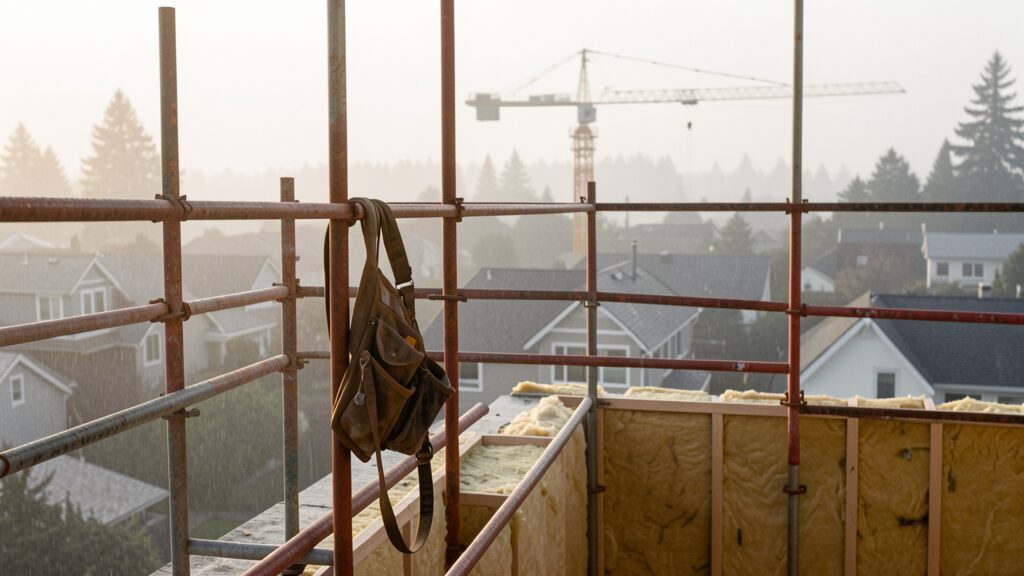
Last Tuesday, KIRO 7 ran a story about ICE arresting a contractor mid-shift on a West Seattle construction site. The crew stopped working. The foreman watched. The man’s tools stayed on the scaffold, and someone’s renovation budget gained a line item for “unforeseen legal costs.” That’s Seattle now: a city where a workday can end without warning, where the cranes keep rising while documents get stamped with the wrong dates.
I read the article while eating toast at my kitchen counter, and I thought about how we all perform stability. The house, the retirement fund, the shared calendar with color-coded appointments. My wife, who manages a commercial beekeeping operation that services orchards east of the Cascades, trusts that the structure holds. She should. I’ve built it carefully.
But every Tuesday, when she drives out to check on the hives, I step into my second city.
The Second Place: What I Keep
I am a married lesbian in Seattle, and I am also, at least some Tuesdays and Thursday afternoons, somewhere else entirely. Not geographically. I’m still within city limits. But the Seattle I enter is one my wife has never seen.
It’s a small studio three blocks off an arterial I won’t name. Someone else might call it a painting space. I call it the place where the noise stops. The walls are unpainted drywall. The floor is concrete with a crack that runs from the window to the baseboard like a river on a map. I keep a kettle and a jar of loose-leaf tea, one chair that belonged to my grandfather, and a drafting table I bought from a retiring architect in Ballard.
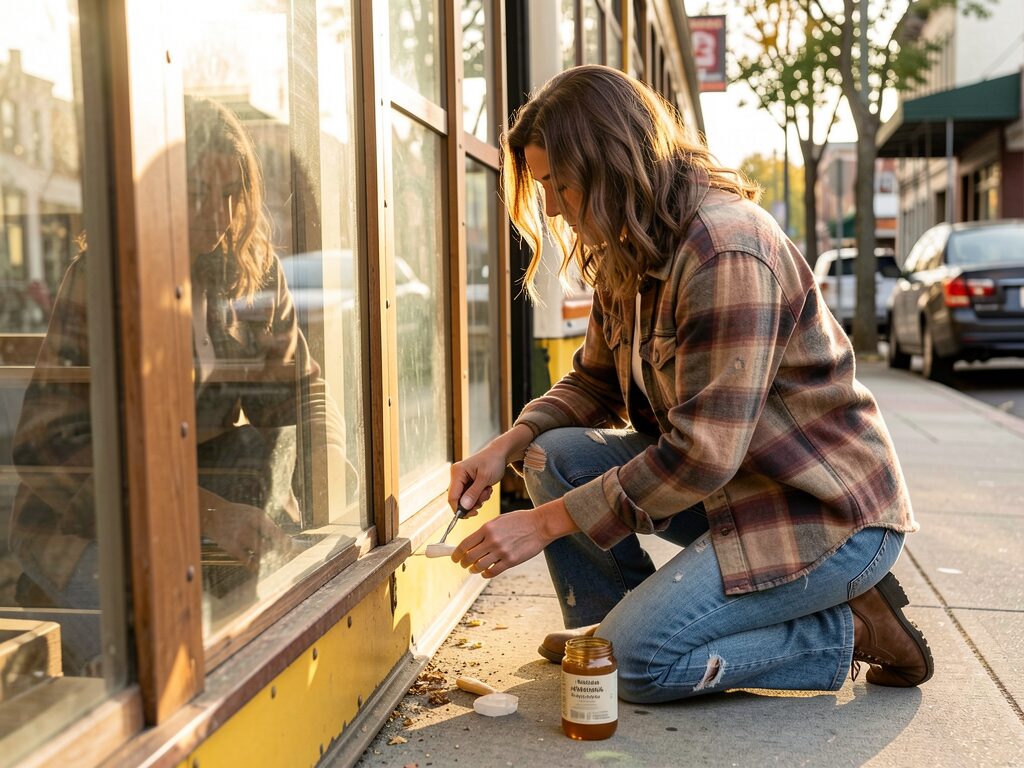
This is where I go to work on things that have nothing to do with my job. My actual profession is something I perform for a paycheck, I restore the original woodwork on historic streetcars for a museum. It’s meticulous, public, and satisfying in the way that fixing something tangible can be. But the studio is where I trace the outlines of what I haven’t yet named. Maps of forgotten neighborhoods. Diagrams of buildings that were demolished before I was born. A growing collection of architectural blueprints I’ve reconstructed from memory.
I don’t show these to anyone. Not yet. Maybe not ever. The point isn’t the finished object. The point is the having of a secret that belongs only to me.
The Houseplant and the Cat
The basil on my kitchen windowsill is dying. I’ve tried everything: less water, more water, singing to it, threatening it. My wife says I’m too hard on plants. She’s right. I have a way of wanting things to thrive that borders on aggression.
The cat, a gray creature named after a minor character in a French film no one has seen, regards the basil with silent contempt. He prefers the paper whites in the guest bathroom, which he chews at four in the morning. I’ve given up stopping him. Some battles aren’t worth the drama.
What the News Doesn’t Cover
The Seattle Times runs a lot of stories about the cost of living. They write about $2,000 studios and tech workers priced out of Capitol Hill. But they don’t write about the cost of living this way—the kind where you pay rent on two versions of yourself.
My wife knows she doesn’t know everything. We’ve been together nine years, married for five. She’s a good person. She’s patient with my silences, generous with her time, and genuinely confused by my inability to understand why the starter needs to be fed twice a week. I love her. That’s not the problem.
The problem is that the person I am at home, the one who remembers to pick up her dry cleaning, who attends her office holiday party, who can discuss the merits of different bee-friendly plantings, is not the same person who sits on a concrete floor in a cold studio tracing the ghost of a building that existed for exactly forty-three years before being demolished for a parking garage.
That person is hungrier. That person doesn’t answer to anyone.
The Luxury of Longing
Here’s what no one tells you about being a married lesbian in Seattle in your early thirties: you can have everything you wanted and still want something you haven’t named yet. That’s not ingratitude. That’s just being alive.
I don’t apologize for it. I don’t feel guilty. This isn’t a confession. I didn’t stumble into this situation. I built it, deliberately, the way you build a garden wall, one stone at a time, knowing exactly what you’re doing even when you pretend you’re just tidying up the yard.
The studio costs $650 a month. I pay in cash. I tell my wife it’s for a storage unit, and she doesn’t ask what I’m storing. Maybe she knows. Maybe she has her own version of this, her own room somewhere, her own secret Seattle. We don’t talk about it. That’s the arrangement: we get to keep something back.
The City Beneath the City
There’s a story I keep in my head. It’s about a block of houses in the Central District that were moved, whole, on flatbed trucks in the 1960s to make room for an expressway that was never built. The houses ended up scattered across three different neighborhoods. Some are still standing. Others were demolished. But the foundations remain, buried under new construction, under driveways, under the carefully fertilized lawns of people who have no idea what’s beneath them.
That’s what I draw in my studio. The foundations. The things that used to be there.
I think about my grandmother, who lived alone for thirty years after my grandfather died. She had a drawer in her bedroom that none of us were allowed to open. After she passed, we found it full of postcards from places she’d never visited, all addressed to her in handwriting no one recognized. She had a second city too. We just never knew its name.
The Season of Letting Go
The Seattle Times reported this week that the Mariners are increasingly likely to trade their starting pitcher before the deadline. The analysis is sober: contracts, performance metrics, the cold arithmetic of what a team is willing to sacrifice for future returns. I read the article on my phone while waiting for the light rail, and I thought about how we all make those calculations. What to keep. What to trade. What to let walk away for nothing in return.
This isn’t a story about leaving my wife. That’s the wrong reading. It’s about the space between roles, the room we make for the version of ourselves that doesn’t have to be legible to anyone. I am not running away from my life. I am expanding it.
What I’m Building
Eventually, I’ll have to decide what to do with the drawings. Maybe I’ll frame them. Maybe I’ll stack them in a box and put them in the basement. Maybe I’ll show one to my wife, finally, and watch her try to figure out what it means.
But not yet. Right now, the pleasure is in the having. The anticipation. The knowledge that on Thursday afternoon, I will walk three blocks off an arterial I won’t name, unlock the door, and sit in a room where no one expects anything of me.
There’s a basil plant dying in my kitchen. There’s a cat that chews paper whites. There’s a woman I love who drives out to check on hives and trusts that the house is still standing when she comes home.
And there’s me. A married lesbian in Seattle, building a city under the city, one line at a time.
It’s enough. It’s almost too much.
And it’s mine.
Meet discreet married lesbians in Seattle
Join a discreet and welcoming community.