The Secret Map of a Married Lesbian in Toronto: A Cartography of Desire
The Known City
She has memorized the city in sound. The distant rumble of the UP Express as it bends toward the island, the percussive clatter of streetcar wheels against steel rails at Queen and Spadina, the low thrum of a jazz trio bleeding through the brick walls of The Rex Hotel on a Thursday evening. These are the coordinates of a life that everyone sees. The life she lives well.
Sasha knows what people think when they see her at a weekend market on Dundas West, carrying a bag of pea shoots and a bottle of natural wine. She knows what her mother assumes when she sends a photo of the newly expanded Leslie Street Spit, the freshly restored 300-tonne crane rising against the lake like a monument to industry and renewal. Look, she texts, they added a zipline. Her mother replies with three heart emojis and a question about the next family dinner.
None of them see the other map she carries.
The Uncharted
The Toronto Star reported last month that the Toronto island airport expansion has been effectively killed by what the Ontario minister called a “fringe group” of activists. The debate, as always, was about who gets to decide what the city’s shoreline should become: a gateway for business travellers, or a sanctuary for birds and cyclists and people who want to hear water instead of engines. Sasha read the article on her phone while standing at the kitchen counter, Elise on the other side of the island, helping Maya with a school project about local ecosystems. The news felt important, though she couldn’t say why. Perhaps because she understood, intimately, the experience of wanting something most people assumed was settled.
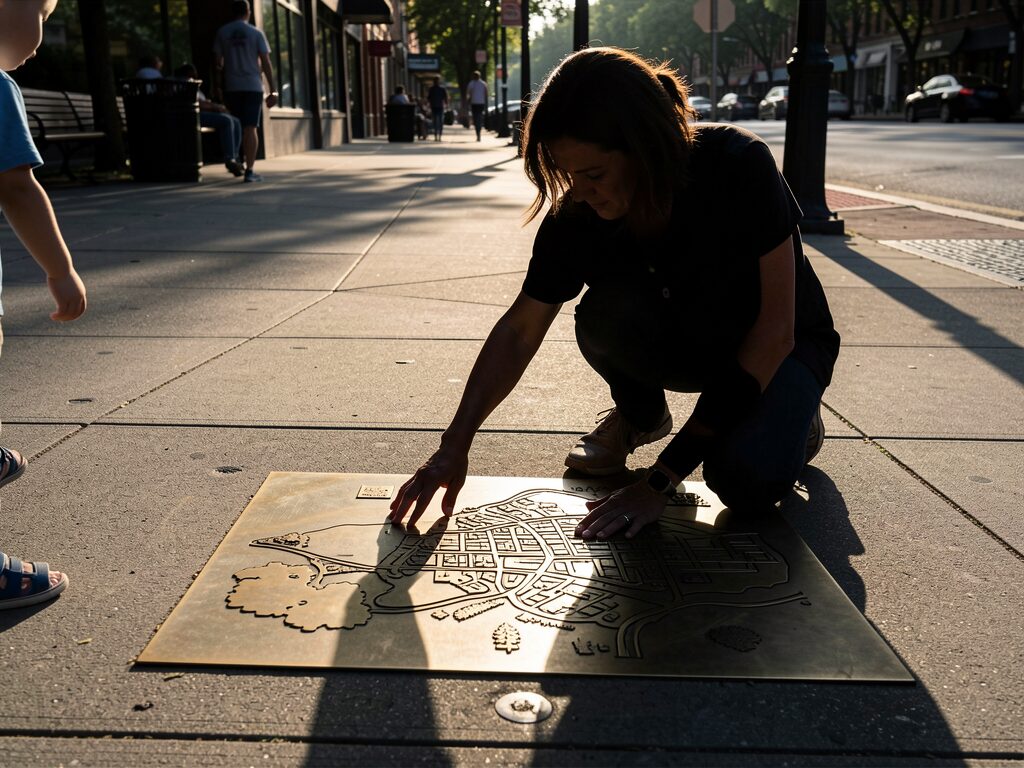
She is a tactile cartographer. It is not a profession anyone expects when she says it at dinner parties. “What does that mean, exactly?” people ask, and she explains: she builds three-dimensional maps for people who cannot see. Raised contours, textured surfaces, thermal and acoustic cues that allow someone to understand a space through touch and sound and smell. Her last project was a model of the Don Valley ravine system, commissioned by a school for blind students in Scarborough. She spent three months studying the way damp earth smells after rain on a trail near Crothers Woods, the particular resonance of a footbridge over a creek, the way the wind changes when you move from open meadow into a canopy of oak and maple. Every detail had to be precise. Every surface had to tell the truth.
The irony is not lost on her. She spends her professional life making things legible through senses other than sight. And still, she has built a second life that relies entirely on things unseen.
The Cartography of Waiting
The wait between meetings is its own territory. It has topography, climate, seasons.
She first noticed the texture of Thursdays about three months ago. Thursday is the day Maya has gymnastics until seven, and Elise works late at the community health centre where she coordinates outreach programs for newcomer families. Thursday is the day Sasha ends up in the east end, ostensibly for a materials consultation with a ceramics studio near Carlaw Avenue. The studio does beautiful work, hand-thrown vessels glazed in celadon and copper, and she did have a legitimate reason to visit. But she stayed longer than necessary. She walked the block twice. She listened for footsteps on the concrete, the specific rhythm she had learned to recognize without ever having been taught.
The affair is not a crisis. It is not a crack in the foundation of her marriage. It is something else entirely, something she has stopped trying to name. She does not apologize for it, even to herself. She does not justify it or plead with the universe for understanding. It simply exists, like the lake that Toronto pretends it doesn’t have, like the airport that a fringe group fought to keep small. Some geographies are contested. Some desires are not meant to be resolved.
Her marriage to Elise is a good one. Nine years together, eight of them married. Maya, now nine, arrived in Sasha’s life when she was five, a quiet girl who drew elaborate castles and asked questions about the names of clouds. Sasha loves them. This is not in question. The love is real and sturdy, like the restored crane on the Leslie Street Spit, visible, functional, a landmark. But love, she has learned, is not a finite resource. It is not an island with a single dock. It can have tributaries, hidden streams that run beneath the surface and emerge somewhere unexpected.
The Renegotiation of Boundaries
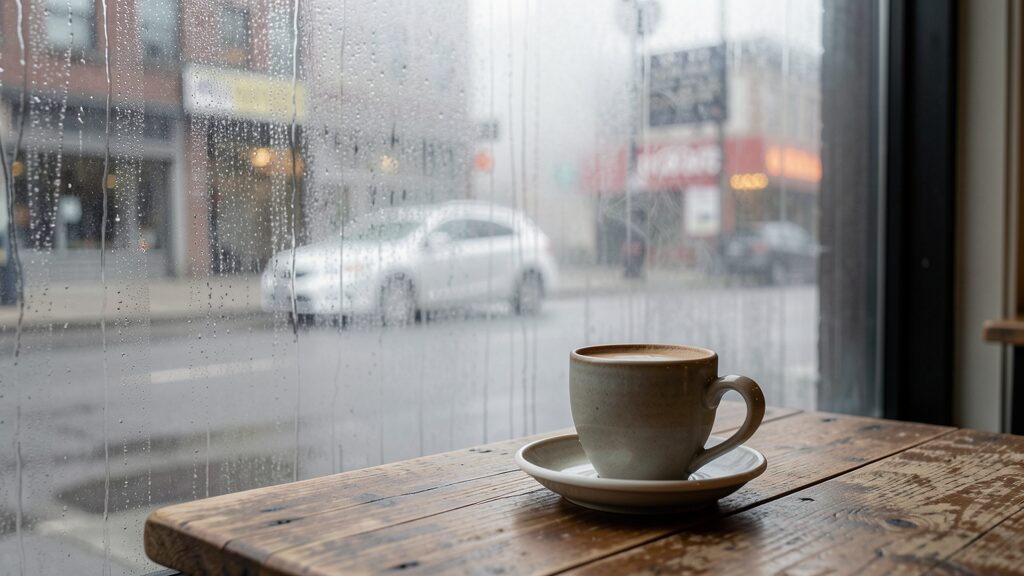
The affair meets her at a café on Brock Avenue, one of those places that exists in the borderland between neighbourhoods, too far west for the Parkdale crowd and too east for Roncesvalles regulars. It smells like cardamom and old wood. The windows fog from the breath of strangers. She orders a latte and sits at a table near the back, where she can hear the door open.
She waits.
The waiting is not painful. It is, in fact, the best part. Because waiting contains everything, all possibility, all potential energy. In the waiting, the woman has not yet arrived, so the woman could be anyone. Could be the version Sasha has constructed in the long afternoons when she is supposed to be mapping the acoustic profile of a proposed park in the Port Lands. Could be the version that exists in the smell of rain on asphalt, the texture of a wool coat brushed against her hand, the specific warmth of a voice saying her name just a little too softly.
When the door opens and she hears that voice, low, slightly rough at the edges, the voice of someone who laughs easily and often, the waiting ends. And something else begins.
They do not touch. Not in public. Not yet. They sit across from each other, coffee growing cold, and they talk. About the island airport controversy. About the new zipline at the spit, which Sasha has not yet tried but wants to. About the ceramics studio, about a film the other woman saw at the TIFF Bell Lightbox, about a neighbourhood cat that has decided the café’s back patio is its personal kingdom. These conversations are the surface of something deeper, the way a topographic map shows elevation but not the caves beneath.
What Sasha wants is not the act itself. She has had that before, in other configurations, other lives. What she wants is the knowledge that it is possible. That she is still capable of this: the electricity of a stranger’s attention, the luxury of being unknown and being chosen anyway. It is a privilege she does not take for granted. She owns it completely.
The Language of Hidden Things
There is a childhood memory she returns to sometimes, unbidden. She is six years old, visiting her grandmother’s house in a small town in Newfoundland. Her grandmother has a pantry full of pickled beets and homemade jam, and Sasha is allowed to press her fingers against the jars, feeling the ridges of the lids, the cool glass, the slight give of the rubber seals. She learns the world through the tips of her fingers before she learns it through words. This is not relevant to her current situation, not symbolic in any tidy way. It is simply a fact about her, a layer of the map.
She brings this memory to the café sometimes. Not as explanation. As company.
The other woman has a habit of tapping her index finger on the table when she’s thinking, a soft, rhythmic pattern that Sasha has come to associate with safety. It sounds like rain on a roof, like the distant pulse of a train moving through the city at night. Sasha could map this woman’s presence in sound alone: the tap, the rustle of her jacket, the way she inhales before she speaks, the particular silence she leaves after a good joke. It is a richer cartography than sight could ever provide.
The Return Journey
They leave the café separately, always. This is not a rule they agreed on; it is a natural law, like the shoreline of an island. Sasha walks south toward the lake, and she lets the city unfold around her: the smell of a Chinese bakery on Dundas, the screech of a streetcar braking, the laughter of teenagers spilling out of a community centre. Toronto is a city of layers, built and rebuilt, contested and reclaimed. The island airport expansion may be dead. The waterfront belongs to whoever shows up to fight for it. This is what she loves about the place: nothing is permanently settled.
When she gets home, Elise is reading on the couch, Maya already asleep. “Good day?” Elise asks, and Sasha says yes, and it is not a lie. The day was good. The day contained everything. She sits down beside her wife, and she reaches for her hand, and she holds it. The finger bones, the familiar warmth, the landscape of knuckles and veins she has known for almost a decade. This is also real. This is also a map she is still learning to read.
The desire she feels is not a threat. It is a room she can enter and leave, a room with a door that only she knows how to find. It is the luxury of a secret that does not need to be confessed. She dares, and it looks good. Not because she is brave or reckless, but because she has learned that some landscapes are meant to be traversed alone, with only sound and touch and the memory of a voice to guide her.
She waits for Thursday. She does not count the days. She does not need to.
Meet discreet married lesbians in Toronto
Verified profiles, free registration, real encounters.