The Geometry of Discretion
I never planned to be anyone’s secret. And that is precisely why I am so good at it.
At thirty-nine, in a city that runs on consensus and daylight, I have become an expert in the territories that exist between what people say and what they mean. Canberra has taught me this, this city of carefully planned roundabouts and hidden valleys, where the public face is always composed and the private life is something else entirely. If you live here long enough, you learn that the most interesting conversations happen in the spaces the town planners forgot to light.
I have been her lover for eighteen months. Not her husband, not her colleague, not her neighbour. Her lover. The word carries a weight I have come to respect. It is not a confession; it is a description of something I chose, freely, and continue to choose every time I walk into a room and see her across the crowd, pretending she is just another acquaintance.
The Threshold
There is a particular kind of silence that exists in the moment before a door opens. It is a loaded silence, charged with everything that has already been decided but not yet acknowledged. I know this silence well. I have stood on one side of it countless times, waiting for the latch to turn, for the air to shift, for the world to reconfigure itself around the fact of our being alone together.
What people misunderstand about discretion is that it is not a burden. It is a discipline, and like any discipline, it offers its own rewards. The reward here is clarity. When you cannot speak openly, you learn to say everything with a glance, a pause, a hand placed deliberately on a tabletop. The reward is also safety, her safety, which I guard more fiercely than my own.
The Canberra Times ran a story last week about a man who discovered he had won forty million dollars in Powerball while watching the evening news. He had been sitting on his couch, ordinary evening, ordinary life, and then the numbers appeared on the screen and everything changed. I read that article three times. Not because I envy his luck, but because I understand the sensation of a life splitting into before and after without any external sign. The man who won forty million dollars still looked exactly like the man who had walked into his living room an hour earlier. People pass him on the street and have no idea.
That is what this is. A quiet transformation, invisible to everyone except the two people inside it.
The Coordinates
Canberra is a city of discrete zones. There is the parliamentary triangle, where everything is symbolic and nothing is accidental. There are the outer suburbs, ordered and green, where families accumulate belongings and routines. There are the lakes, the galleries, the university precincts. And then there are the in-between places, the motels that cater to public servants on overnight business, the late-night cafés in Kingston where nobody asks questions, the walking paths along the Molonglo River where you can have a conversation that was not on any official agenda.
We exist in these in-between places. Not because we are hiding, but because they are the only spaces that belong to neither of our official lives. They are neutral ground, and neutrality, in a situation like ours, is a form of grace.
I have a colleague, Sarah, who restores vintage sewing machines as a hobby. She can tell you the exact year a Singer was manufactured from the shape of its tension assembly. I know nothing about sewing machines, but I admire her precision. She applies the same meticulous attention to her work as she does to her machines, and when I watch her examine a seized-up mechanism, I think about how easy it is to mistake neglect for failure. A machine that has not been oiled in fifty years is not broken; it has simply been forgotten.
I do not believe in forgetting. I believe in attention.
The Inventory
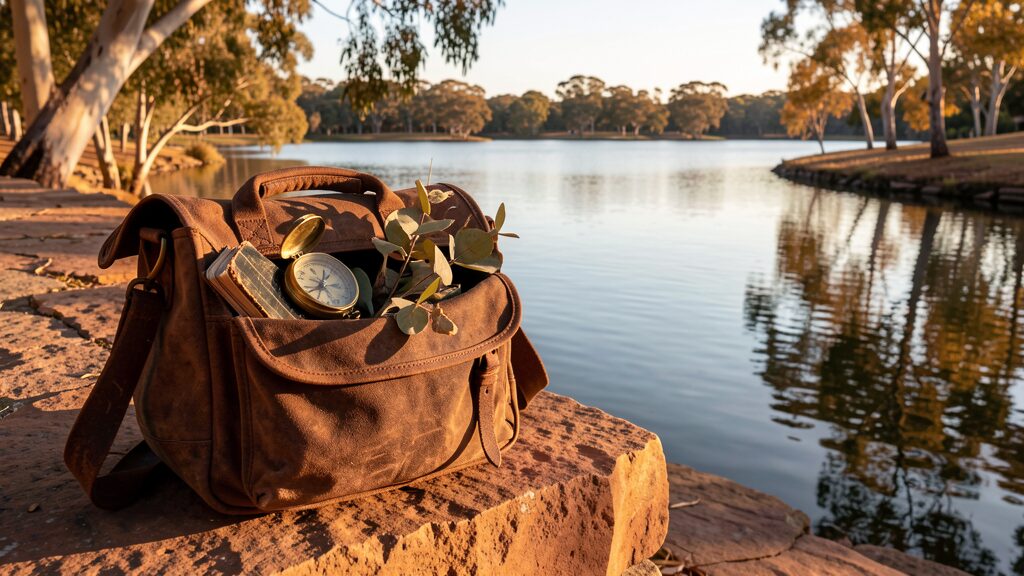
Let me tell you what I carry with me. Not guilt, I said this is not a confession, but the tools of the life I have chosen.
I carry her schedule in my mind, cross-referenced against my own, the overlaps and gaps calibrated like a flight plan. I carry an awareness of time zones, not literal ones, but the temporal distances between her family commitments and mine, the hours that belong to obligation and the hours that remain available.
I carry the knowledge of how to be invisible without being absent. How to leave a gathering early, not late. How to never be the topic of conversation by never being remarkable enough to mention. How to laugh at a joke in a crowded room while she laughs too, both of us knowing that the real joke is something only we understand.
I carry her trust, which is the most fragile and the most durable thing I have ever held.
An old friend once told me that every relationship is a conspiracy of two. She was right, but she did not go far enough. Every relationship is a conspiracy, but the conspiracy is against loneliness, not against anyone else. We are not plotting to harm. We are plotting to survive the ways that life, in its ordinary course, can make you feel like a stranger to yourself.
The Music
There is a particular piece of music I associate with her. I will not name it, because naming would make it traceable, and we must not be traceable. But it is a piece built on repetition with variation, the same phrase returning again and again, never quite the same, building toward something that only reveals itself at the very end if you have been listening carefully enough.
That is what our time together sounds like. The same motifs: a conversation that begins at the same café and ends somewhere else entirely; a drive through the hills in the late afternoon, the light falling differently every time; a silence on the phone that says more than words could. The variations are everything. They are the reason I am still listening.
When I was a child, I spent a summer learning to skip stones on a lake near where my grandparents lived. My grandfather taught me: find a flat stone, hold it between thumb and forefinger, snap your wrist at the last moment. The goal is not to make the stone sink, but to make it dance across the surface, touching and releasing, touching and releasing, until eventually gravity wins.
I have never found a better metaphor.
The Silence
We do not discuss the future. This is not pessimism; it is a recognition that the present is demanding enough. We live in a city where the weather changes every fifteen minutes and the political landscape changes even faster. If POLITICO is launching a Canberra Playbook team, as the news reported last week, it is because there is value in understanding how things actually work here, the informal networks, the unspoken agreements, the deals that never appear in any official record.
Our relationship operates on similar principles. There are no contracts, no promises, no declarations. There is only the ongoing decision to show up for each other, again and again, in the ways that are possible.

Some people would find this unbearable. I find it clarifying. Without the scaffolding of expectation, every moment we share is a choice. Not an obligation, not a habit, not a default. A choice.
I remember once driving back from a work trip to Sydney, the Hume Highway stretching out in front of me, the radio tuned to a station I did not recognise. Somewhere past Goulburn, the signal dissolved into static, and I drove for a while in silence. It was not uncomfortable. The silence was full of things I did not need to say.
The Return
The hardest part is not the secrecy. It is the return.
I am not talking about going home to my own life, I have made my peace with that, and I will not disparage it. I am talking about the moments after we have been together, when the world reasserts its claim. I am talking about the walk to the car, the drive through streets that look exactly the same as they did an hour ago, the re-entry into conversations that have nothing to do with what just happened.
There is a vertigo to those transitions. You have been in one reality, and now you are in another, and nobody else knows the difference. You carry the afternoon inside you like a secret organ, pulsing out of sight.
I have learned to manage this vertigo. I take the long way home. I slow down. I let the feeling settle, the way you let a cup of tea cool before drinking. Rushing would be disrespectful, to her, to myself, to the hours we carved out from the indifferent march of days.
The Reflection
I look at myself in the mirror sometimes, and I see a man that nobody in my official life would recognise. Not because I look different, but because I know something they do not. I know what it feels like to be chosen, not as a default, not as a habit, but as a deliberate act of will. I know what it feels like to be the refuge, the place where someone can stop pretending.
This is not a critique of anyone else. It is simply a fact.
The lover in Canberra learns to live with double vision, seeing both the surface and the depths, the public story and the private one, the Canberra that appears in guidebooks and the Canberra that exists in the gaps between. We are not unique to this city, but this city is uniquely suited to us. It is a place built on the premise that what is visible is only a fraction of what is real.
I am thirty-nine years old. I have a profession that interests me, a family situation that I respect, and a secret that I protect. I am not a victim of circumstance, and I am not a protagonist in someone else’s drama. I am a man who made a choice, and continues to make it, every day.
The door opens. The silence breaks. I step through.
And I am not sorry.
Find discreet lovers in Canberra
Authentic profiles, guaranteed privacy, free access.