What the Mechanical Thrush Knows: Diary of an Unfaithful Wife in Brighton
The Crowd Below
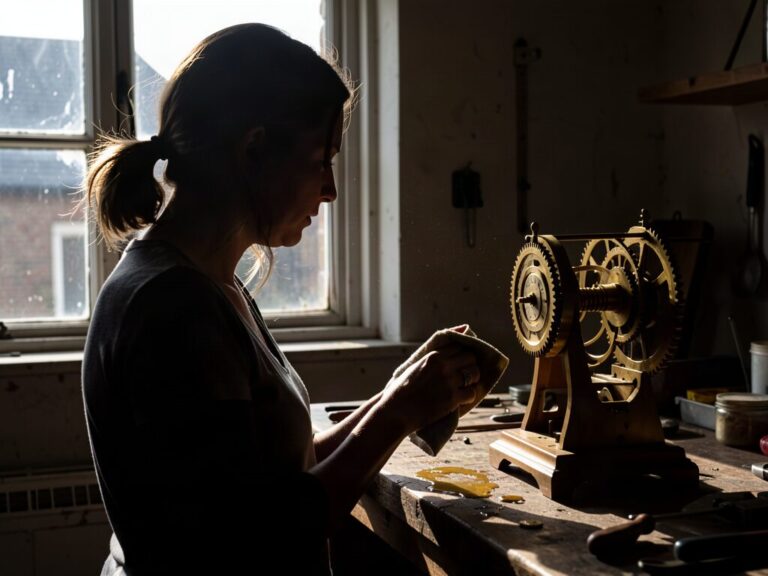
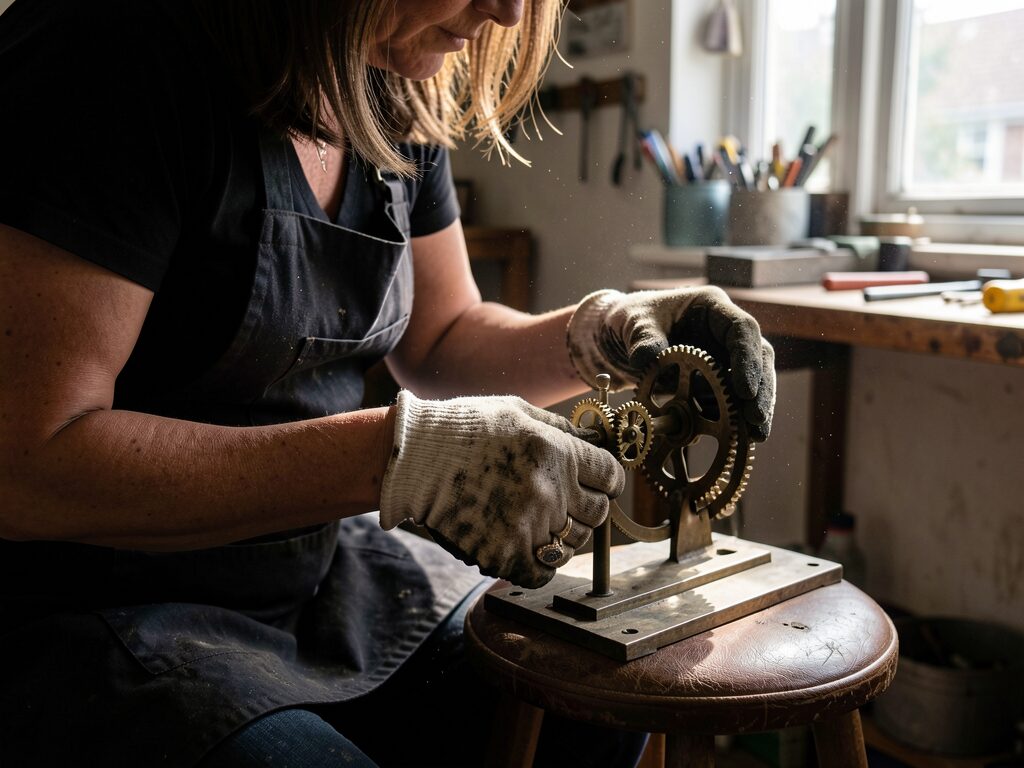
The workshop in the North Laine smells of shellac and the peculiar peace that only inanimate things can provide. Miriam, forty-three, spends her days restoring automata, the brass birds, the wheezing clowns, the clockwork acrobats that once delighted Victorian drawing rooms. She is meticulous. She is patient. These are the same qualities that make her an effective liar.
She was walking along Ship Street last summer, carrying a shoebox of spare gears, when she heard the commotion. A crowd had gathered on the pavement, heads tilted skyward, phones raised like tiny shields. According to the Guardian, Nick Cave had decided, without warning, without fuss, to play a secret rooftop gig in Brighton, and the city had stopped, mid-stride, to listen. Miriam stopped too. She stood among strangers, craning her neck, listening to the voice and guitar bleed through the damp sea air. There was something illicit about it, the way a private moment had been offered publicly but only to those who happened to be there.
The song finished. The crowd roared. Miriam continued walking, and she felt the smallest twitch of something she couldn’t name. It was the same feeling she got, nowadays, when she heard the door of the workshop two doors down open and close. A man named Ivor was on the other side of that door, and she had been waiting nine months for him to notice her the way she had noticed him.
A Restorer’s Log: Entry One
Her workbench is covered in the familiar debris of her trade: small screws in tin lids, a wooden jaw that needs re-pinning, wing feathers from a thrush that had lost its nerve. The current project is a singing bird, circa 1880, damaged in transit. The bellows are worn, the cam that animates the tail has slipped, and one of the hollow glass eyes has a crack that catches light at an unusual angle. She has been working on it for four weeks. It is, she tells her colleague Nessa, “a patient creature.”
Nessa, who collects vintage hat pins and uses them to hold her hair in a neat coil while she works on Venetian glass, lifts an eyebrow. “The bird. Right.”
Nothing escapes Nessa. That is why Miriam loves her and also why she must be careful. Nessa has noticed the way Miriam’s hair is no longer always in the practical bun. She has noticed that Miriam no longer wears her watch to work. She has noticed that Miriam now takes lunch at odd hours, precisely when the barometer restorer from two doors down takes his. Nessa says nothing. She slides a hat pin through her own dark coil, and the gesture is gossip enough.
The workshop is a conservation studio in an old factory conversion, filled with women like Miriam and, increasingly, men like Ivor. He is not a man one would naturally describe as magnetic. He is in his fifties, quiet, with the careful hands of someone who understands that glass and brass require patience. He smells of varnish, always. It has become, for Miriam, the most erotic smell in the world.
They met formally, as it were, when his workshop ran out of tea. He appeared in her doorway with an empty mug, and said, “I’m told you have the restock.” She pointed to the cupboard. He said, “I’m Ivor.” She said, “Miriam.” The entire exchange lasted less than a minute. But in that minute, he had looked at her hands, at the way she was holding a tiny brass pin with such waiting tenderness, as if that habit mattered. He had looked at her hands as though they were the most delicate mechanism he had encountered in years.
That was nine months ago.
The Science of Anticipation
She tells herself, still, that this is not an affair. But the unfaithful wife in Brighton knows better. The label is sticky and accurate. What she feels for Ivor is not love, at least not yet. It is a more dangerous substance: anticipation. The anticipation is the affair. The meetings are mere punctuation.
There is something scientific about it. Researchers at the University of Sussex have demonstrated that the brain’s reward system often lights up more powerfully during the expectation of a reward than during the reward itself. The dopamine arrives before the experience, not during it. Miriam read that somewhere and felt vindicated. She is not waiting for a happy ending. She is waiting for the sound of his door latch, and the waiting itself has made her body a stranger to her, a body she is just now learning to inhabit.
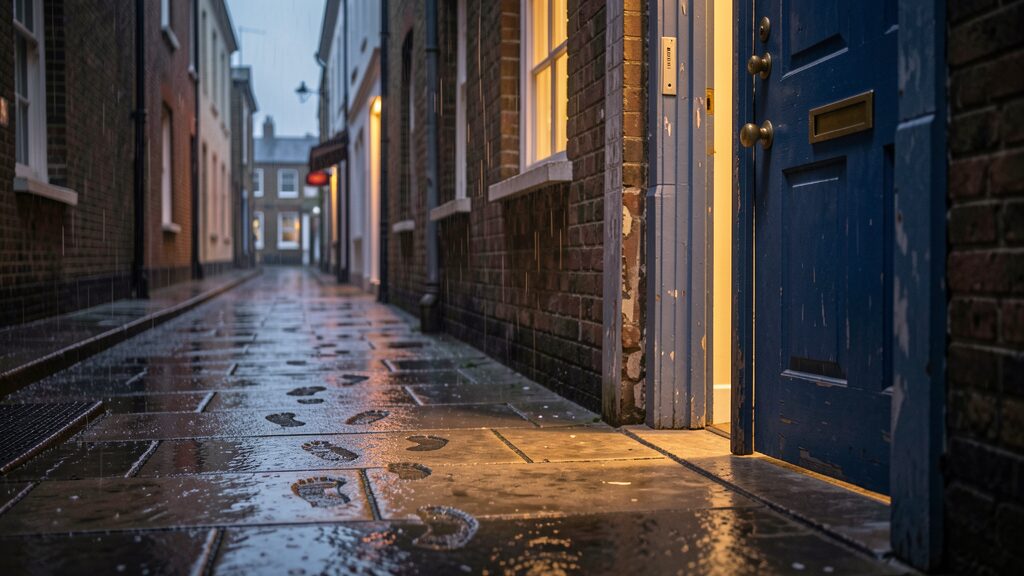
Here is what she hears when she waits. The gritty complaint of the door to the stairwell. The heavy tread of his boots, which he wears even in summer. The cough he gives before he puts the kettle on, a small flag of presence. And beneath all of that, the ticking of the various clocks and automata around her, all the mechanisms she has managed to keep alive. She stands at her workbench with the thrush in her hand, and she can feel its spring under her thumb. The wait between the key turning and the first notes of the bird’s song is, she now thinks, the most beautiful moment in the entire mechanism. Sound is not the point. Sound is the end of waiting.
She knows his everything. She knows that he has a moustache but trims it only on Sundays. She knows he is married too, she has never met his wife, and she does not want to. She knows that when he laughs, it comes out surprisingly loud and brief, like a door banging shut in a draught. She has collected these details the way she collects the pieces of a shattered automaton: carefully, knowing that some of them will never fit back together, but loving the shape of them anyway.
Two Hours a Fortnight
They meet every other Thursday. It is not planned. It is not scheduled. It simply happens, because if it were scheduled, it would become a routine, and a routine would be a relationship, and a relationship would be an affair. They meet instead by accident: she goes to the deli for olives, and he goes for a newspaper, and they stand beside each other at the counter as though the universe has arranged it, which it has, the universe being two people who have rearranged their own calendars silently and without witness.
In the deli, the glass counter gleams. The lights hum. The man behind the counter weighs out green olives into a paper tub, and Miriam watches Ivor’s hands as he opens the newspaper to the crossword. He is already holding a pen. He offers it to her, point down, the way one might offer a tiny tool of deliverance.
“I thought you might like to finish it,” he says. His voice is low, slightly sanded. She takes the pen. Their fingers do not touch.
This is the moment she replays afterward, in the dark, while Robert breathes his heavy hill of breath beside her. The pen. The point down. The way he said “finish it”—as if the crossword were something they were doing together, as if everything were something they were doing together.
That is the difference. That is why this is not just an affair. At home, Miranda, no, Miriam, is the wife, the mother. She signs permission slips. She makes risotto. She listens to Robert’s stories about the sixth formers who cannot grasp quadratic equations. She loves them. She does. But being loved and being seen are, apparently, different mechanics. Robert sees her, in the way one sees a familiar chair: useful, expected, part of the furniture. Ivor sees her the way one sees a mechanism about to sing. The before and after of it is unbearable, and yet she lives in the before. She lives in the waiting for Thursdays, in the knowledge that the door will click, that the tread will sound, that the world will briefly arrange itself around a pen held out point down.
The rest of the week is the after. The after is the risotto. The after is the school gate. The after is the hallway, where she stands with her coat still on, listening, and Robert is in the front room, and the television is a low blue murmur. She has never felt more visible than in that hallway, waiting. The lying is a form of aliveness. Every time she says “Fine, just tired,” she feels the gears of her secret turning inside her, and the secrecy itself is a kind of warmth.
The Key
She keeps a brass key in her pocket. It is not a key to anything. It came from a clock she dismantled years ago, a key that opened a door that had already been lost. She carries it now because it feels like Ivor’s key, because they both carry things that open nothing. He has his own, a sturdier key for adjusting barometers, but the symmetry pleases her. They are both bearers of small useless keys, granted entrance to nothing official, only to the interiors of each other’s attention.
It is Wednesday night. She is in the bathroom, door locked, steam rising from the bath. The mirror has fogged, but she does not wipe it. She does not need to. She knows what she looks like. She knows what she used to look like. The difference is invisible to everyone except her, and perhaps to Nessa, who said this morning, “You’ve stopped wearing your watch.” That was all. But it was everything.
She runs her thumb over the teeth of the brass key. She thinks of the deli, of the pen, of the exact texture of Ivor’s voice. She thinks of the thrush, still waiting for her tomorrow, its mechanism repaired, its song dormant in the bellows.
Tomorrow is Thursday. Tomorrow she will go to the deli. She will stand beside him and they will not touch, and she will want to, and the wanting will make the rest of the week bearable. She is an unfaithful wife in Brighton. She is a mother, a wife, a restorer of dead mechanical things. Today she was none of those things. Today she was only a woman with a key in her pocket, waiting for a door, and the door had not yet opened, and the waiting was the truest part of her.
She blows out the candle. The steam cools. She goes to bed in the dark house, and the last thing she touches before sleep is the key.
Meet discreet married women in Brighton
Authentic profiles, guaranteed privacy, free access.