The Day I Stopped Counting the Years
I turned forty in March, and my husband gave me a Vitamix. I’m not being ungrateful; it’s a very good Vitamix, the kind with the pre-programmed smoothie settings. He wrapped it in the Sunday comics and watched me open it with the earnest satisfaction of a man who had solved a problem I didn’t know I had. I think that was the moment. Not a dramatic rupture, not a slammed door, but the quiet click of a lock closing on a room I was supposed to live in for the rest of my life.
I am a forensic accountant. I know, it sounds like the punchline to a joke about being boring, but the reality is that my job is about stories. I spend my days reading the bones of failed businesses, tracing the skeletal remains of embezzled funds, finding the emotional truth in a ledger. I find the place where the numbers lie. I find the hidden accounts, the secret reserves, the double-entry bookkeeping of a life that is not what it appears to be. For sixteen years, I have been married to a man who is a master of the single entry. His ledger is simple: wife, kids, house, job. Balanced. Predictable. Solvent.
But a ledger is not a life.
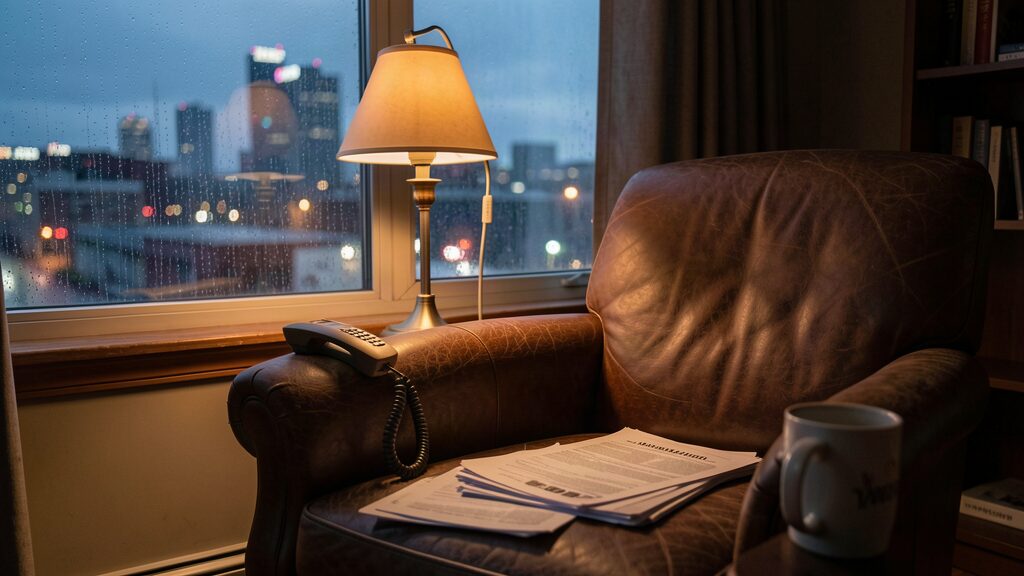
The affair started, as these things often do, not with a bang but with a whisper. It started with a voice on the other end of a phone line, a contractor auditing a subsidiary I was investigating. We never met for weeks, only spoke in the sterile language of financial compliance, depreciation schedules, capital expenditure, cash flow. But his voice was a subtle instrument. It had a timbre, a slight rasp, like a well-worn leather armchair. He laughed at my dry observations, and I found myself, for the first time in years, trying to be funny. I would rehearse anecdotes in the car on the way home, little stories about my day, not for my husband, but for the voice that would come to life at 9 PM after the kids were in bed.
According to a recent Pew Research Center study, the number of Americans who believe marriage is essential for a fulfilling life has dropped significantly in the last decade. It’s a statistic that I used to find depressing, a sign of societal decay. Now I find it oddly comforting. It suggests I’m not a deviant; I’m part of a demographic trend. The data gives me a place to stand.
Our first meeting was not in a hotel room. It was in the parking lot of a Kroger on the outskirts of town, a transactional location chosen for its anonymity. He had to drop off some documents; I had to pick them up. We stood there, two professionals in the sodium-vapor glare of the parking lot, and the air between us was thick with the months of conversation. He smelled of rain and sawdust and coffee, a weirdly intoxicating combination that had nothing to do with the Lincoln he drove. He didn’t try to kiss me. He just handed me the manila envelope, his fingers brushing mine for a fraction of a second longer than necessary. In that single touch, I felt more seen than I had in a decade of marital intimacy. It was the anticipation that was the real event. The drive home was a haze of scent and sensation.
I am not here to confess. I am not here to justify. I am here to testify to the fact that I, a 40-year-old unfaithful wife in Nashville, am alive. This city, which is built on the back of country music, a genre that has canonized the suffering of cheated-on wives from Kitty Wells to Carrie Underwood, has given me the perfect backdrop for my own private rebellion. The soundtrack to my affair isn’t a sappy ballad; it’s the low hum of the city itself. The rumble of a truck on I-440, the distant whistle of a train crossing the Cumberland, the cicadas screaming in the humid summer nights. Nashville, as the Tennessean recently reported, is in the middle of a massive data center boom, with the Metro Council even using eminent domain to block a proposed data center near the Nashville Zoo to protect the animals’ peace. There is a frenzy of construction, a sense of building and rebuilding, and it feels like a mirror for my own life. We are both tearing things down and putting up new structures, often in places where they don’t quite seem to belong.
The affair is a luxury. Let’s be clear about that. It’s not a desperate clinging to a life raft; it’s a planned, deliberate vacation from my own existence. It’s a spa treatment for the ego, a gourmet meal after years of microwave dinners. My husband is a good man. He manages the local branch of a non-profit that coordinates disaster relief. He is kind, patient, and teaches our children, a 12-year-old daughter and a 9-year-old son, how to fish and fix their bikes. He is reliable in a way that is both his greatest strength and the source of my deepest ennui. I don’t want to hurt him. I simply want to feel something other than the gentle, suffocating comfort of a life that fits like a well-worn shoe.
The affair, my husband never disparaged. He is the solid ground, the foundation. But I am the second story, the part of the house that sees the sun.
The details of the encounters are not the point. The point is the space between them. It’s the Tuesday afternoon where I leave work early, telling my partner I have a dentist appointment, and instead I park my car in a shaded lot and simply sit. I listen to the sounds of the city, the carillon bells from the downtown church, the whoosh of a city bus, the chatter of a mother scolding her child. I am nowhere and I am everywhere. I am waiting. The waiting is a sensation in itself. It’s a low, humming voltage that runs under my skin for days. I can taste the coffee he drinks, a dark, bitter espresso, always with a single sugar cube. I can mentally feel the fabric of his shirt, a weathered, soft chambray. The anticipation is a sensory buffet I consume in my mind long before the real feast.
We meet in small, mundane places. A private room in a meadery in Germantown. A quiet booth in the back of a French bistro in Wedgewood-Houston. A short-term rental in East Nashville that smells like lavender and cedarwood. The locations are a carefully curated pilgrimage. But I never remember the interiors. I remember how the world looks from the passenger seat of his car, the way the streetlights blur into streaks of gold and mercury. I remember the weight of his jacket placed over my shoulders when the air conditioning is too cold. I remember the sound of his voice, that voice, reading a headline from the local paper, his breath warm against my ear. It is these preludes, these postludes, these interstitial moments that are the true architecture of the affair. The act itself is a mere period at the end of a long, beautifully crafted sentence.
He is a land-use attorney. He navigates the Byzantine zoning laws of a city exploding with development. He fights for green spaces, for community gardens, for the soul of a city being paved over for luxury condos. He is a man who spends his days fighting for the intangible, for a quality of life that is constantly under threat. In that way, we are kindred spirits. I chase the intangible truth hidden in the numbers; he fights for the intangible quality of a place. We are both in the business of preservation, trying to protect something real from the relentless march of progress.
And yet, there is a stark reality that grounds me. I recently read a government report from the Tennessee Department of Health about the rising rates of anxiety and depression among women in their late thirties and forties, the “sandwich generation” squeezed between the needs of their children and their aging parents. I fit the profile perfectly. My mother, who lives in Murfreesboro, had a fall last spring, and the responsibility for her appointments and her prescriptions has fallen squarely on my shoulders. My daughter is entering the treacherous waters of middle school, and my son needs help with his math homework that is far beyond my pay grade. I am the CEO of a family that is constantly in crisis. The affair is the one area of my life where I am not required to be a manager, a problem-solver, a fixer. I am just a woman who is wanted.

There is a small human contradiction I must admit to. For years, I have been a vocal advocate for school uniforms. I think they make mornings easier and level the playing field for kids from different economic backgrounds. My opinion is steadfast, practical, and unassailable. But last week, as I was getting dressed for a meeting with him, I spent a good twenty minutes agonizing over which pair of earrings to wear, the small pearls or the silver hoops. I had a sudden, fleeting, irrational thought: I shouldn’t have let my daughter talk me out of those. She’s too young to understand the difference between dressing for a crowd and dressing for a singular pair of eyes. I do. It’s a vanity I don’t regret, but I recognize the hypocrisy.
This is not a story about the destruction of a home. It’s a story about the construction of a self. I have built a second life, a shadow existence, and it is filled with light that my primary life can’t see. My husband and I make love, I call it that for lack of a better word, on Saturday nights, a concession to habit and the late-night comedy shows we watch after. It is a pleasant, unambitious act, like a game of checkers. What I have with him is a game of three-dimensional chess, played over weeks, with every move calculated and savored.
I know how this story is supposed to end. In the country music canon, the unfaithful wife either dies of a broken heart, gets run out of town, or is left to drown her sorrows in a bottle of cheap whiskey. But Nashville is changing. The city is becoming a hub for healthcare, for technology, for a new kind of cosmopolitanism, and its stories are changing with it. This is not the Nashville of rhinestones and prison blues. This is the Nashville of surgical precision and data streams, of a woman who analyzes risk for a living and chooses her own.
The other day, my husband and I were walking through Centennial Park. The Parthenon was glowing in the late-afternoon sun. He reached out and took my hand. His palm was warm and dry. I didn’t pull away. I let him hold it. But I wasn’t thinking of him. I was thinking of the taste of a dark-roasted espresso, the sound of a specific laugh that could make me feel like the smartest woman in the room. I wasn’t feeling guilty; I was feeling the dual sensation of being anchored and being free. This is the secret the old songs don’t tell you. You can be both. It’s the most beautiful lie I’ve ever told myself, and I live in it, fully real in the city of the unreal.
The days before I see him again are the hardest and the best. I find myself listening for his voice in other men. I smell his scent on the wind, a phantom ghost of sawdust and rain. I will find reasons to drive past the bistro where we have a reservation on Thursday. The anticipation is a physical ache, a hunger that no food can satisfy. It is in this space of waiting that I am most truly myself, a woman who knows exactly what she wants, and is willing to wait an eternity, or at least until Thursday, to get it. And that is the power of being an unfaithful wife in Nashville. I have learned to appreciate the foreplay of the mundane, the sensuality of a held glance, the eroticism of a scheduled phone call. I don’t wait for my life to happen to me anymore. I sit in the driver’s seat, a passenger in my own car, and I wait for the moment when I get to walk into that room and feel, for a few stolen hours, the pure, unadulterated thrill of being chosen.
Meet discreet married women in Nashville
Join a discreet and welcoming community.