The Map on the Ceiling
I began noticing the crack in the plaster above our bed about eighteen months ago. Not the marriage’s crack, that had been there for years, a hairline fracture we both stepped around without acknowledgment. No, this was an actual fissure in the ceiling, starting near the light fixture and snaking toward the window. I stared at it most nights while my husband slept with his back to me, breathing the even rhythm of a man untroubled by questions. The map of that crack became something I knew by heart. Every branch, every dead end. I could have traced it blindfolded.
The ceiling is repaired now. I hired someone myself. He came on a Tuesday, mixed the compound, smoothed it over. Told me it would need a second coat. I didn’t tell my husband. He hasn’t looked up in years.
I am 44 years old. I have been a structural engineer for twenty-two years, specializing in the assessment and rehabilitation of aging bridges. It is a profession that sounds romantic to people who don’t understand it. They imagine wind on observation decks, dramatic photographs taken from precarious angles. The reality is administrative: reports, load calculations, corrosion analysis, meetings with municipal officials who cannot decide whether to repair or replace. I spend most of my days inside a fluorescent-lit office on the south side of Edmonton, staring at spreadsheets that quantify decay.
My husband and I have been married for seventeen years. He is a good man. He remembers anniversaries, replaces the filter in the water pitcher, does not leave dirty socks on the bedroom floor. We have a thirteen-year-old daughter who plays cello with more determination than talent, and a ten-year-old son who collects rocks and organizes them by density. We are, by every external measure, a functional family. We eat dinner together four nights a week. We attend parent-teacher conferences. We have never missed a recital.
None of this is untrue. None of it is the whole story.
The Single Moment
There is a difference between being seen and being perceived. Being perceived is what happens at the grocery store when the cashier scans your items and asks if you found everything okay. Being seen is something else entirely.
I had not been seen in a long time. Not as a woman. Not as someone with contours and edges and a private interior world. I was my children’s mother, my husband’s wife, my clients’ engineer. I was a series of functions performed reliably. I was the person who remembered to schedule the furnace maintenance and pack the snacks for the hockey tournament. I was useful. I was invisible.
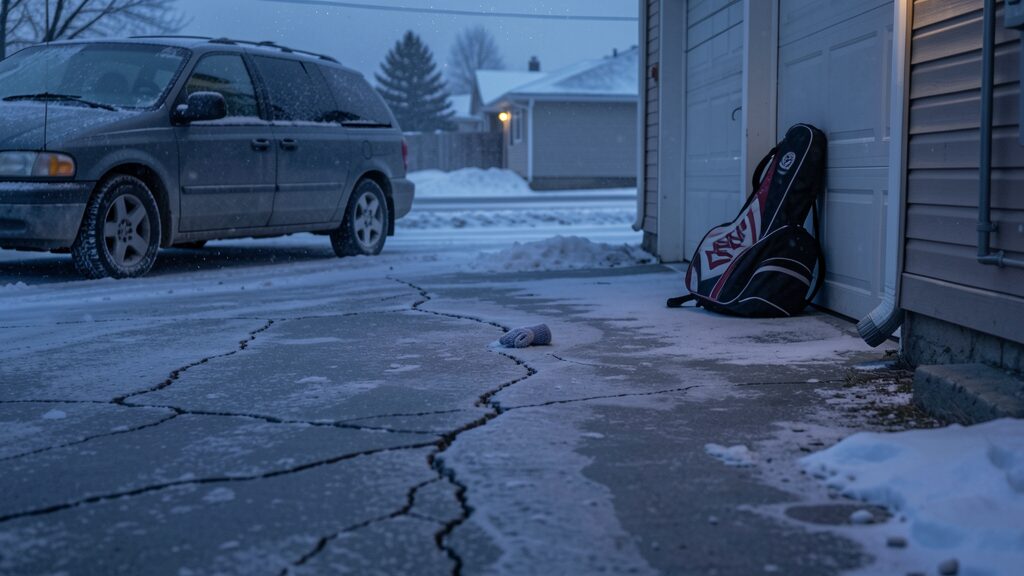
Last January, according to the Edmonton Police Service, officers were called to a “suspicious death” in central Edmonton. A man in his fifties had died from injuries sustained during an altercation. Police sought dashcam footage from anyone who had been in the area between midnight and three in the morning. I read the article on my phone while waiting for my daughter’s cello lesson to end. The victim’s name was not released pending family notification. I remember thinking: someone’s life ended in a parking lot on a cold night, and before that, someone else had chosen to hurt him. Cause and effect. A sequence of decisions leading to an irreversible outcome.
I thought about decisions a lot that winter. The ones we make. The ones we refuse to make. The ones we make by not making them.
The Afternoon Light
I met him in February. Not through an app, not through a website. I want to be specific about this because the narrative people construct, the lonely housewife scrolling through profiles at 2 a.m.—is not mine. I met him at a conference in Calgary. Structural engineering is a small world. He works in forensic engineering, analyzing failures. Building collapses. Balcony failures. The physics of things falling apart.
We had coffee between sessions. Then dinner. Then a conversation that lasted until the hotel bar closed. He asked me what I thought about when I couldn’t sleep. He asked me what I would do if money were not a consideration. He asked me what I wanted, not what I needed or what was responsible or what made sense for the family. Just what I wanted.
I could not answer. Not because I didn’t know, but because no one had ever asked. The question sat in my chest like something newly alive.
We exchanged numbers. Professional, we told ourselves. Contacts in the same field. But the texts began: a photograph of a peculiar crack in a concrete beam. A late-night thought about a project I had mentioned. A question about a book I had recommended. The waiting between messages became its own geography. I would check my phone in the parking lot before picking up the kids, in the bathroom during dinner prep, in bed after my husband had fallen asleep.
The anticipation had a texture. It was the weight of the phone in my palm. The slight vibration before the notification sound. The way my own handwriting looked when I wrote his initials in the margin of a meeting agenda, then immediately crossed them out.
The Shape of a Day
We met again in March. And April. Edmonton has a particular quality of light in the spring, thin, hesitant, as though unsure of its welcome. I would drive to a coffee shop on the other side of the city, sit at a table near the window, and wait. The sound of the espresso machine. The scent of ground coffee and wet pavement. The minutes passing like something precious I was choosing to spend.
I never touched him in public. That was not the point. The point was being in a room where someone was actively looking for my arrival. Where my presence changed something. Where I was not background.
There is a study from Pew Research Center that I remember reading last year, something about married adults and emotional intimacy. The statistic that stayed with me was this: roughly a third of married people say they do not feel close to their spouse. A third. That is millions of people sharing beds with someone they no longer reach for. I thought about that number in the coffee shop. I thought about the mathematics of loneliness. I thought about how a statistic is just a collection of individual silences.
I have a snake plant in my office that I keep killing. It is supposed to be impossible to kill. I have repotted it three times. I have tried less water, more water, different light. It turns yellow no matter what I do. I tell myself I will start over with a new one, but I never do. I water it out of habit, watching it slowly fail, as though failure itself were a kind of commitment.
The Waiting
Between our meetings, the waiting became its own ritual. I would wake early, before anyone else, and sit in the dark kitchen with a cup of coffee that I did not drink. I would replay the last conversation. The last text. The last laugh that caught me off guard. The anticipation was not about what would happen next in any physical sense. It was about the moment when my phone would light up with his name. The moment when someone chose to speak to me, specifically me, when they could have chosen anything else.
I stopped looking at my watch. I had always been obsessed with time, punctuality was a virtue I wore like armor. But now time felt different. It passed differently when there was something to wait for.
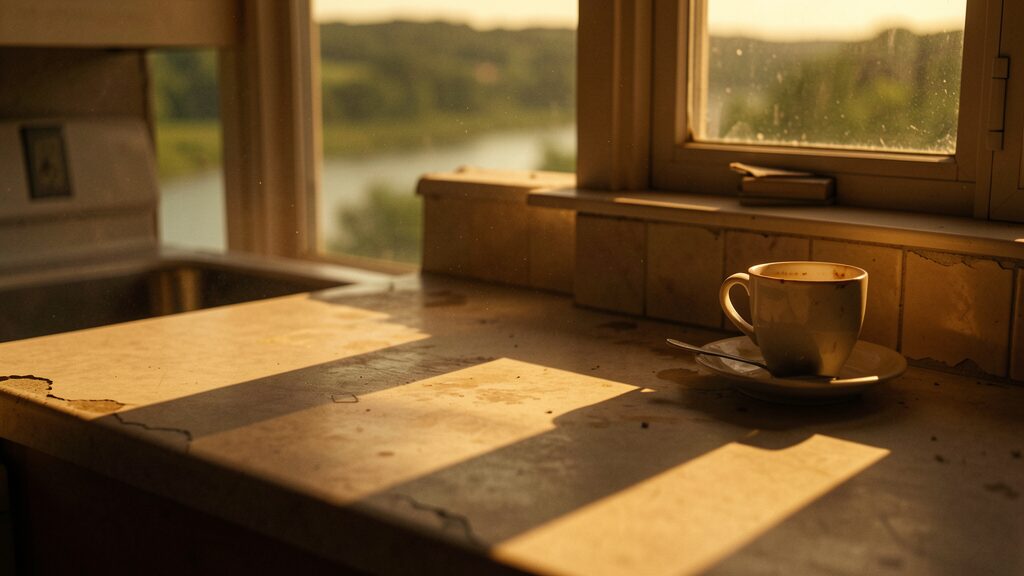
The infidelity, if you want to call it that, is not a series of events. It is a rearrangement of attention. I began to notice things I had stopped seeing: the evening light through the kitchen window at a certain angle, the exact shade of green of the river valley in June, the way my daughter’s hand looked on the neck of her cello, adult and child at once. I was paying attention because someone was paying attention to me. That is the transaction, I think. That is what I did.
The Edges of the Map
I have not left my marriage. I do not know if I will. That is not the shape of this story. The shape is this: I am 44 years old, an unfaithful wife in Edmonton, and I do not regret a single moment of it. Not the texts. Not the meetings. Not the lies I told to be somewhere else, to be someone else, to be seen. I own this the way I own the reports I write, with full knowledge of the load it carries, the stress points, the probability of failure.
The man I meet has a name. I will not write it here. He has his own life, his own reasons, his own cracks in the ceiling. We are not each other’s escape. We are each other’s recognition.
I still read the news. Edmonton police are investigating another suspicious death, this time in the parking lot of a strip mall on the north end. These stories accumulate. They form their own map of the city, a cartography of violence, choice, consequence. I drive past that strip mall sometimes. I think about the people whose lives ended in places they did not expect. I think about how every decision matters, even the small ones. Especially the small ones.
I still do not know how my snake plant keeps dying. I told him about it once. He suggested it might be root rot. He spoke as though the plant could be saved. I liked that.
The ceiling is smooth now. No crack. No map. I look up, and there is nothing to trace. I am not sure if this is a loss or a gain. Perhaps it is both. Perhaps everything is both.
I have not made any decisions. I have only made room. And in that room, someone saw me. I will not apologize for wanting that.
Meet discreet married women in Edmonton
Verified, discreet, no strings attached.